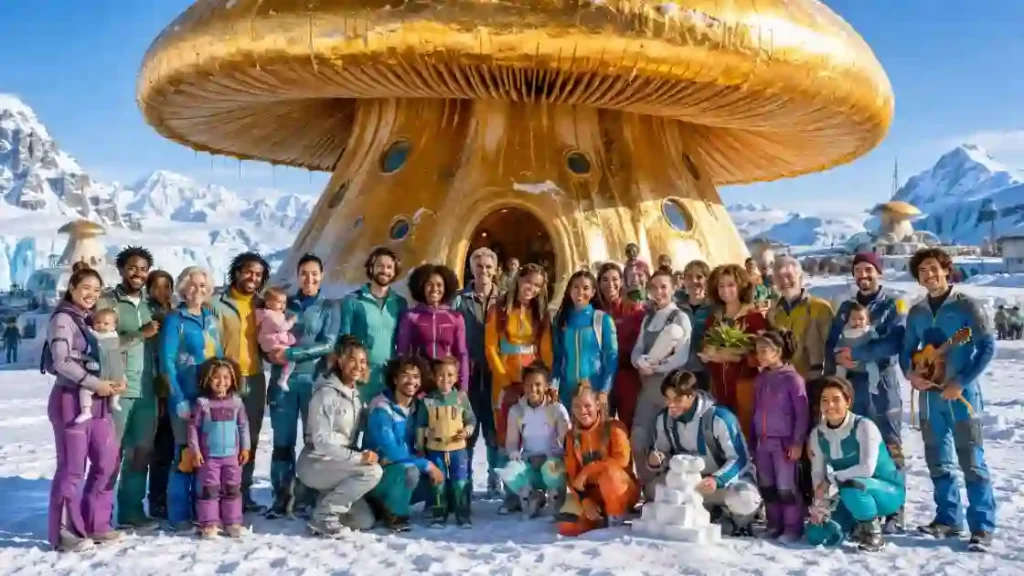
The People of Felicia
The Chronicle of Felicia estimates that the people of Felicia number about two billion individuals, most of them climate and political refugees and their descendants. They came from every country and background, driven south by war, persecution, upheaval, and climate change. Felicia offered what many had lost elsewhere: food, shelter, freedom, and a place to belong. The Colossal Golden Mushroom made abundance possible. Food and shelter ceased to dominate everyday life, while the Centiki economy helped finance the farms, factories, cities, and enterprises required by an exploding population.To an outsider, Felicia is extraordinarily diverse. To Felicians, this is simply normal life. The State does not classify its citizens by race, religion, marital status, or level of education. People mix, form families, work, play, and socialize without being sorted into official demographic groups. Felicia has a distinctly youthful population. All generations are visible, but children, adolescents, and young adults are unusually numerous. With food needs covered in abundance, people thrive and families flourish. Babies and children remain part of ordinary public life rather than being separated from it.Everyone in Felicia is an educator. Parents teach their children social conduct, but learning follows curiosity. When a child feels drawn to an occupation or subject, the child seeks tutoring from someone who practices it. A sculptor may teach someone else’s child sculpture, a musician may guide a young musician, and a banker may teach a child fascinated by finance. Children find their path by following their interests. The long Antarctic winter changed us. People craved the physical presence of other people, and social life gradually moved away from computer terminals and gathered around hydrogen fires. Each fire draws together people with a shared interest. They talk, eat, laugh, teach, and play together. Felicia itself grew one village at a time. The villages first spread along the coast and then followed the retreating glacier line inland. The village remains the basic territorial and social unit of the country, keeping everyday life close to other people. The population is changing with the country. Generations are being shaped by abundance, the Antarctic environment, constant human contact, new patterns of education, and a society unlike the ones their ancestors left behind. Given enough generations, Felicia may produce more than a new society. The people of Felicia may produce a new branch of humanity: Homo sapiens antarcticus.