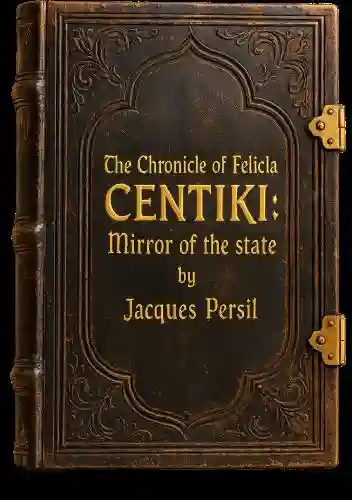
The Chronicle of Felicia
The spy tale and its author
The Chronicle of Felicia is a series of books written by Jacques Auguste Persil. The first volume, Centiki: Mirror of the state starts with events in 1996 that later lead to the birth of the State of Felicia. Like any history book it offers the reader plenty of war stories if you are into that sort of thing. You can find wars between nations, wars between factions within nations, and occasionally wars between spouses within the factions within nations. Even though Persil’s personal drama permeates every page, the book series has no confirmed literary value. It is just an invaluable tool for historical researchers. Every fact mentioned is confirmed by ample documentary evidence.
There is one immediate practical use for the book besides the litany of home remedies for the common cold: the book Centiki: Mirror of the State inadvertently leads the reader to the catacombs, the most important destination along the Centiki labyrinth. There, the reader can easily learn the word of the day and register to play the stock market simulation game. When Persil appeared on Oprah in 2079, he confessed that he regretted making these revelations. He wanted to keep the game and the catacombs roller coaster all for himself.
Sadly, for unknown reasons, the last volume is only halfway finished. The last word in the last half-finished sentence is parsley. That’s how the manuscript was attributed to the author. Persil means parsley. This is the most intriguing of all the volumes. The oddity of this fragment is that it was handwritten on 16th-century parchment, and it bears Persil’s impeccable calligraphy. Carbon dating of the parchment reveals that it was crafted on November 28, 1520, at precisely 16:37, the same instant the Magellan Expedition finished crossing the Strait of Magellan in search of a shorter route to Cathay, the medieval name for China. But there’s a twist. The manuscript was found in southern China. See the problem? The name Cathay traditionally referred to northern China, while Marco Polo called southern China Mangi.
The mystery surrounding The Chronicle of Felicia
All the details about the Chronicle of Felicia and the author are shrouded in secrecy. The Internet, the Smithsonian, and the French Embassy are all mute on the subject. Why the last volume, in manuscript form, was found in an archaeological dig near Mianyang, in Sichuan province, China, among other 16th-century artifacts? Why? Find the answer in the book. At the end of the first volume, Persil acquired several artifacts along with the Basset fortune. One of them was “What Panda Eats”, a research paper in a Chinese history journal. It was written in 1965 by Henry Puyi, the last emperor of China. Throughout the first three volumes of the book, the riddle in the history journal article has been Persil’s true nemesis. Jacques Persil had an unreasonable fear of ticks. His wife Amira helped him overcome this fear. Only then, was Persil able to solve the puzzle. The connection: 1,400 pandas, or 80% of the wild giant panda population live in Sichuan Province, mainly in the newly created sanctuaries. Most of the captive pandas. totaling 800 individuals, also live in Sichuan. Maybe the manuscript spurred the creation of the sanctuaries in the first place. The Chronicle of Felicia advocates strongly for conservation. Persil was an accomplished spy. We should look for the answer in the secret intelligence community.
That’s why we make a strong appeal to all our citizens. If you or a close one works, or has worked, for a secret intelligence organization, big or small, contact us immediately. Tell us everything you know. You’ll provide a great service to the State of Felicia. You will be recognized before our entire community.