The People of Felicia
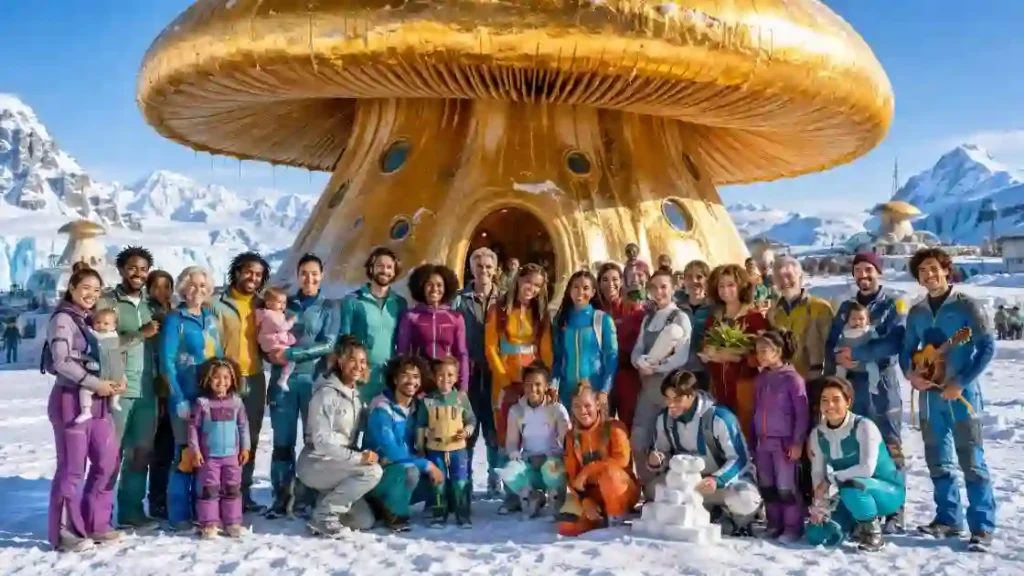
The people of Felicia number about two billion, according to The Chronicle of Felicia. Most are climate and political refugees and their descendants. The first settlers made camp on Argentina’s Antarctic claim. Others came from every country and background, driven south by war, persecution, upheaval, and climate change. Felicia offered what many had lost elsewhere. Here they could find food, shelter, freedom, and a place to belong.
How the People of Felicia Built a Home in Antarctica
For a family arriving in Antarctica, the promise of free food and shelter took an unusual form. Every citizen was entitled to a Colossal Golden Mushroom. A door cut into its hollow stem gave the family a home. The same living organism supplied food and heat. As settlements spread along the coast, clusters of golden mushrooms marked the villages. Later generations followed the retreating glacier line inland.
A mushroom could house a family. Building a fishing fleet took the savings and labor of many villages. The Centiki economy helped finance the boats, farms, factories, and transport that a growing population needed. Centiki’s own people joined the migration south. Members of its old Board of Directors settled among their neighbors, the ki became Felicia’s national currency, and the Centiki Exchange became the Stock Exchange of Felicia.
Village Life Among the People of Felicia
Felicia grew one village at a time, and the village remains the basic unit of the country. Even a great Felician city consists of villages. A citizen knows the boundaries of one in a practical way. These are the people who stop to talk, know the children by name, and remember where yesterday’s argument left off.
To an outsider, Felicia is extraordinarily diverse. To Felicians, this is simply normal life. People from different backgrounds work together, form families, and raise children. The State keeps no register of a citizen’s race, religion, age, marital status, or level of education. Felicians consider these private matters.
All generations take part in village life, though a visitor soon notices how young the country is. Abundant food has allowed families to flourish. Children, adolescents, and young adults are unusually numerous. Babies go along to public gatherings in a parent’s arms. A child can grow up knowing the older people in the village simply by spending time in the same places.
Everyone in Felicia Is an Educator
Parents teach their children how to behave toward other people. What a child learns next often depends on whose work catches the child’s eye. A girl who watches a neighbor carve a figure can ask the sculptor to show her how to hold the tool. A boy who keeps returning to hear a musician play already knows whom to ask for his first lesson.
The same holds for less visible occupations. A child who wonders how a village paid for its fishing boats may find a willing tutor in a banker. This is what Felicians mean when they say that everyone is an educator. An adult with a skill worth learning may one day find someone else’s child at the door.
Around the Hydrogen Fires
The long Antarctic winter changed us. People craved the physical presence of other people. Little by little, they left their computer terminals and gathered around communal hydrogen fires. Each fire drew people with a shared interest. Around one, a game might last all evening. Around another, a musician could play while the youngest listeners fell asleep in their parents’ arms.
The fires also gave Felicians a place to disagree. In a country where every citizen is a legislator, a question about traffic safety can begin with two neighbors who use the same crossing. They can discuss a change around the fire, then use the village terminal to bring their proposal to the Citizen Forum. Whatever the rest of the country decides, those two neighbors will meet at the crossing again.
Future Generations in Antarctica
For the first settlers, Antarctica was the place they reached after leaving home. For their grandchildren, home is the village where they grew up, the workshop where someone taught them a trade, and the fire where their friends gather through the winter.
What might happen after hundreds or thousands of generations in such a place? The people of Felicia have already built a society their ancestors could scarcely have imagined. Given enough generations, Antarctica may yet give rise to a new branch of humanity. Its name might be Homo sapiens antarcticus.